Probing Toxic Chemicals in the Ag Reserve

Probing Toxic Chemicals in the Ag Reserve

February 22, 2023

A class of toxic chemicals called PFAS can contaminate water, farmland, wells, and crops.  These chemicals have been linked to cancer and other diseases and do not break down in the environment.  An organization called PEER (Public Employees for Environmental Responsibility) is leading an effort to probe whether PFAS chemicals are present—and if so, to what degree—on Ag Reserve land and in water sources.  

Testing to date has yielded concerning results. Levels of several forms of PFAS (per- and polyfluoroalkyl substances of which there are thousands) are substantially higher than EPA recommended quantities in drinking water in Poolesville. As a result, the town closed two of its 12 wells. These concerning results also led SCA and Montgomery Countryside Alliance (MCA) to join PEER in January in calling on Montgomery County officials to prohibit the use of certain PFAS-containing fertilizers, called biosolids, on county agricultural land—to prevent further contamination of ground and surface waters.  

PFAS in such fertilizers have led to shutdowns of dairies, ranches, and other farming operations in states from Maine to New Mexico. In Maryland, lab testing found high levels of PFAS in certain fertilizers. These products are used on county agriculture fields, golf courses and public lands.  PFAS from biosolids migrate to surface water and groundwater. They are also absorbed by plants and ingested by humans and livestock.

PEER and its affiliated groups are now exploring the logistics of testing for PFAS in other areas of the Ag Reserve. If you’re interested in learning more, contact Tim Whitehouse at PEER, twhitehouse@peer.org.

Read More
Supporting Regenerative Agriculture

Supporting Regenerative Agriculture

February 22, 2023

SCA is a strong advocate for regenerative agriculture (regen ag). What is that?  It’s an umbrella term referring to an array of agricultural management and production practices that aim to: improve soil; sustain arable farmland; sequester carbon; increase biodiversity; provide healthy forage for farm animals; reduce the use of agricultural chemicals; and promote the growth of high-quality food.  

Regen ag can also help increase food security and climate resiliency amid the challenges of climate change.  Changing weather patterns and extreme weather events are expected to put many food-growing areas in the U.S. at risk. Improved soils hold water better, in flood and drought.  Increasing the amount of food grown locally will help ensure adequate crop growth and food supply. And it will protect against supply chain disruptions, such as those the occurred during the pandemic. Regen ag can also increase the sequestration of carbon in soils.

Read More
Testing Agrivoltaics in the Ag Reserve

Testing Agrivoltaics in the Ag Reserve

January 5, 2023

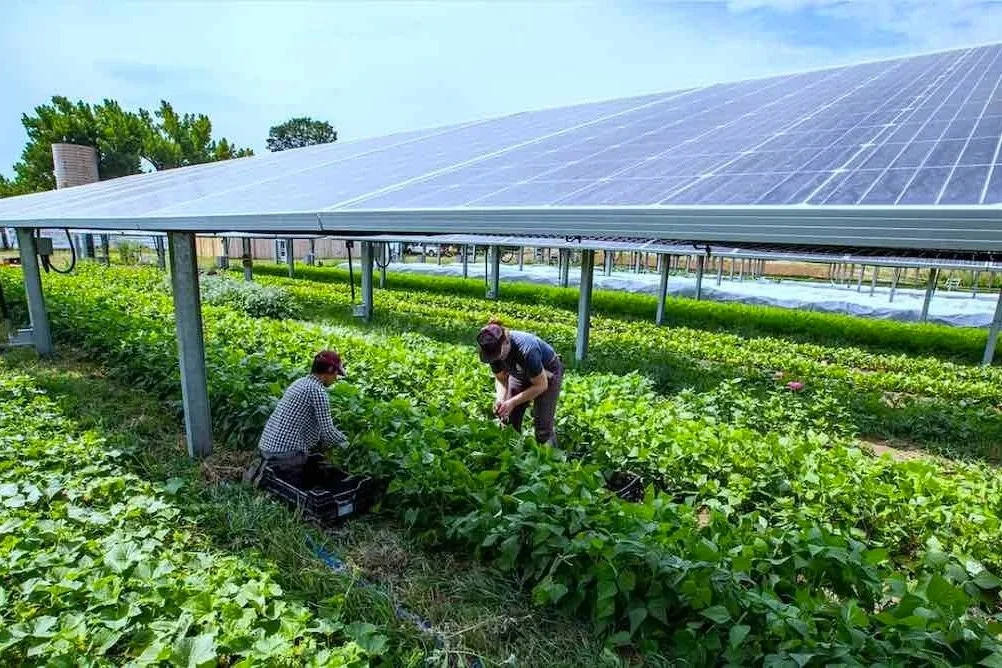
“Agrivoltaics,” is a new buzzword in solar energy circles. The term applies to land used for agriculture (“agri”) and for generating solar energy (“voltaics”) by solar panels. Agrivoltaics can refer to just a few solar panels mounted on ground-based structures (as opposed to rooftops) or a whole field of them, with crops or animals grazing underneath.

A successful agrivoltaic project has some type of farming thriving adjacent to or under the panels, with the panels generating sufficient power to justify the economics of constructing and installing them. That can be a tall order—but not an impossible one. Agrivoltaics projects are very much in the research phase. The approach is not a fully proven yet, though it’s being viewed as workable under the right circumstances. For now, much of what’s known about agrivoltaics has come from research in dry areas in the western U.S. Some of these areas are sunnier and hotter than the Mid-Atlantic region in the summer and colder in the winter. Thus, agrivoltaic projects that are successful out west aren’t necessarily relevant to the Mid-Atlantic.

Other concerns and potential downsides are emerging. Ground solar panels can disturb and compact soil. They also decrease the amount of sun that reaches plants, affecting photosynthesis. And ground panels can adversely affect how much rain reaches plants and in what pattern. For example, run-off from panels can cause water to pool in some areas. Another practical concern is how farmers get equipment in and around ground panels. All these issues, and others, are being studied. 

Agrivoltaic proposals for the Ag Reserve

In 2020, Montgomery County adopted a zoning change that allowed solar arrays on land zoned for agriculture in Montgomery’s County’s Ag Reserve. The measure was a compromise. It recognized the need to generate more renewable energy in the county while at the same time preserving farming, especially on the county’s best soils. The measure also encouraged more production of rooftop solar. It increased the allowable amount of solar production for landowners from 120% of their personal use to 200%. That meant people could sell any excess solar electricity they generated back into the electricity grid. Community solar arrays, which are smaller than “utility scale” arrays, are also allowed under the measure. They can produce up to 2 megawatts of electricity, and generally require 10 to 12 acres of land. Importantly, placing solar arrays on farming soils designated class 1 or class 2 (high quality soils) is prohibited.

Read More