County Council Approves 18-month Pause on Data Centers
Updated July 29, 2026
The Montgomery County Council on July 28 unanimously approved an 18-month moratorium on large-scale data centers.
None can be approved, and no applications for data centers can be processed during the moratorium and before the County develops zoning rules regulating them.
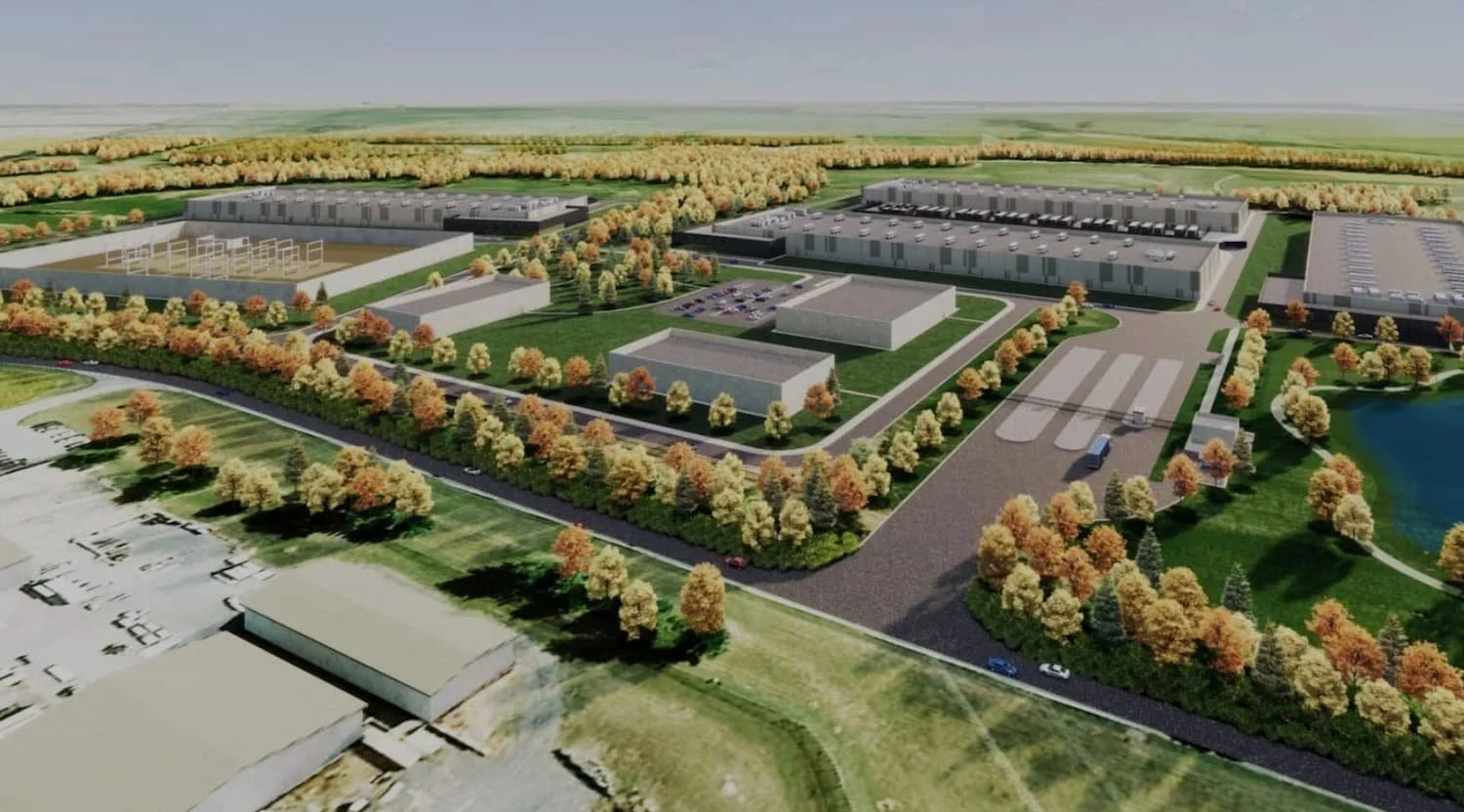
The measure encompasses the proposal by a company called Atmosphere to build a 110-acre, 5-building data center campus in Dickerson.
The Council also adopted a definition of “large-scale” or “hyperscale” data centers to clarify the kind of facility it seeks to stop for now.
The 18-month pause is intended to allow the Council and other County officials to thoroughly evaluate the risks posed by large data centers, and to draft regulations that will specify where they can be built and what rules they have to abide by.
There’s tension in that space already. Atmosphere released an updated plan and analysis of its proposal on July 20. The company is saying it will likely be unable to meet certain desires and requests from County lawmakers and advocacy groups. And the company’s CEO, Chuck McBride, told media outlets he was “disappointed” in the Council’s approval of the moratorium.
“Throughout this process, we worked collaboratively with the Council and other stakeholders to demonstrate that the Dickerson Data Center Campus is a unique redevelopment opportunity and to develop what we believe would be one of the most sustainable data center campuses possible,” McBride told The Banner.
The company had filed an appeal against a previous 6-month administrative moratorium imposed by County Executive Marc Elrich, asserting he had overstepped his authority. A similar suit against the Council’s measure would almost certainly be unsuccessful. Notably, the company has threatened numerous times since January to abandon the project if a moratorium was imposed.
Per the company’s July 20 project analysis, some County officials and advocacy groups would like to see aggressive efforts to use cleaner renewable energy to power the proposed facility. The company is asserting, however, that the mix of power sources for the Dickerson data center will not be able to meet “unrealistic” renewable energy goals—due to restraints inherent in the power grid in the mid-Atlantic area.
Issues around water use (from the Potomac River), noise, the role of the facility’s diesel generators, taxation, and other challenges also need addressing. The company claims it is striving to achieve “best practices” in these areas. But no independent assessment of its plans has yet been done.
The moratorium is a clear victory for County residents’ advocacy. On June 16, some 80 people testified at a public hearing on the issue; the vast majority supported a moratorium. Hundreds of other citizens have submitted written comments in recent months, also overwhelmingly supporting a moratorium.
Montgomery County, with this action, becomes the latest jurisdiction in Maryland and nationally to place pauses on data centers approvals.
The reasons are now quite straightforward: lawmakers and citizens alike are just beginning to understand this complex technology and its significant scope and potential impact (positive and negative) on communities.
Many jurisdictions, including Montgomery County, now realize they must involve independent experts to help assess data center proposals.
The 18-month pause means that the present Council and the next Council—as well as a new County Executive—will be dealing with this issue.
Both the new Council and County Executive assume office at noon on Monday, December 7. Importantly, re-elected Councilmember Marilyn Balcombe will be Council President in 2027 and provide an important bridge and leadership on data centers. She has been the lead person to date drafting the data center zoning ordinance.
Background: Explosive growth
The data center train is fast moving—nationwide. That’s by intent. The industry is taking a rapid expansion approach for these reasons: (a) to leverage the hype around AI; (b) to garner as much investment as possible from venture capital firms and banks; (c) to counter mounting localized opposition to the potential environmental and land-use hazards associated with data centers; and (d) to meet perceived demand for AI and the power generation needed to support it.
On this last point, the data center industry is working hand-in-glove with the energy sector to dramatically ramp up power generation dedicated to data centers. This partnership threatens plans across the country to mitigate climate change through sharply reduced use of fossil fuels.
Some facts:
The U.S. has more data centers than any other country—some 5,400 (of all sizes) as of the end of 2025. Another 3,000 are under construction or in the planning stages. Of those, more and more data centers every year are large-scale (called “hyperscale” in the industry) with multiple buildings on large tracks of land (sometimes farmland).
Data centers now consume around 4.4% of all power in the U.S. That’s forecast to rise to 8% by 2030.
A report in January 2026 (by the North American Electrical Reliability Corporation, a non-profit) cited the mid-Atlantic as one of four U.S areas most vulnerable to electrical power shortfalls and blackouts over the next five years—largely due to data center power needs.
The data center explosion is monopolizing the construction industry and its workers—carpenters, electrical workers, certain engineers. In some states, that’s leaving fewer such skilled workers to build homes amid a nationwide shortage of affordable housing.
Water usage is a central concern. One study estimated that data centers in 2023 consumed some 17 billion gallons of water for cooling—some of that in states like Arizona where long-term water supply problems are dire.
Data centers contribute to rising rates for home electricity—though the magnitude of the impact differs from region to region.
The above issues require urgent attention. But the causes must be acknowledged. There’d be no explosive data center growth without the equally explosive growth of data use by government, industry and consumers—cell phones, tablets, computers, the internet, email, texts, streaming, cloud storage, and, of course, now AI.
Here’s one eye-popping forecast: total digital data generated worldwide is projected to grow from 182 zettabytes in 2025 to 394 zettabytes in 2028—within just three years! A zettabyte is 1 trillion gigabytes. One zettabyte is roughly equal to as much bits and bytes of data as there are grains of sand on all the world’s beaches.
At the highest level of concern is this question: will the much-touted economic and social benefits predicted from AI be worth the risks it poses? No one knows. With this technology, we are building the airplane as we fly it.
Our region—Now at the leading (bleeding?) edge
A big chunk of the national data center explosion is right in our neck of the woods. Northern Virginia is home to the highest concentration of data centers in the country (665) and is one of the busiest data hubs in the world.
It was thus only a matter of time before the industry cast its eye across the Potomac River. That began in earnest in 2021 with a proposal for a 2,100-acre data center campus near Adamstown in Frederick County. The proposal included 43 miles of underground fiber optic cables beneath the Potomac River linking the proposed campus to the Loudoun County hub.
So, in large part, the Adamstown location is an expansion of Loudoun County’s infrastructure.
Amid growing opposition, Frederick lawmakers in late 2025 adopted new zoning that expanded the potential footprint of the Adamstown campus to 2,615 acres. Meanwhile, the under-river cables were laid in 2023-2024 and construction has started on several data center buildings. A few of those are projected to start operating this year. The entirety of the $25 billion Adamstown project is expected to be completed in the mid-2030s. It’ll end up as one of the largest industrial projects in the mid-Atlantic region.
The Dickerson Project
By comparison, the proposal for a 110-acre, 5-building data center campus in Montgomery County, near Dickerson, is relatively small. However, if approved, it would be one of the larger industrial projects in the County in years. Notably, it, too, is tied into Loudoun County’s infrastructure via a portion of the under-river fiber optic cables.
These VA-MD interconnections could prove significant over time. The current federal (under Trump) and Maryland state (under Wes Moore) administrations are data center-friendly. They may see economic advantage in the linked infrastructure being created in the Virginia-Maryland area. A further concern is whether the federal government or Maryland state will push to usurp county authority on where data centers can be built and what rules they must follow.
In August 2022, a company called Terra Innovations (also known as Terra Energy) bought 740 acres in Dickerson that includes a decommissioned (in 2020) coal-fired power plant. About 255 of the 740 acres are zoned “heavy industrial” (where the power plant was). Most of the remaining 485 acres is zoned “AR” for Agricultural Reserve.
Nearby, also on industrial zoned land, are the County’s trash incinerator, a natural gas power plant, and a 100-acre yard waste compost facility.
Notably, the entire area’s access to electrical infrastructure makes it highly desirable for industry.
Terra’s owners have kept SCA and Montgomery Countryside Alliance (MCA)—as well as County officials—apprised of some of their plans since 2023.
In January 2024, Terra submitted an application for conditional use approval of the data center site (not the actual data center) to Montgomery County’s Office of Planning and Development. MCA and SCA communicated with planning staff and Montgomery County Executive Marc Elrich at that time that the conditional use application did not satisfy the legal requirement for the permit.
In October and November 2024, planning officials held initial internal sessions and hearings on the proposal. At those, Terra acknowledged the proposal was a preliminary land use submission and did not contain any final specifications for a data center campus.
Caroline Taylor, MCA’s executive director, was the only community member who provided testimony at the October 2024 quasi-judicial hearing before the Montgomery County Office of Zoning and Administrative Appeals (OZAH). She did so on behalf of MCA and SCA. Ms. Taylor raised concerns that the proposal lacked sufficient detail to grant any kind of final or near-final approval. For example, Terra provided no site plans, specific details about energy/power use, or the use of Potomac River water for cooling purposes. Terra indicated they or a data center company would provide all that in due time.
Ms. Taylor asked if the OZAH hearing examiner had ever granted such a preliminary permit. The answer: No. Ms. Taylor further asked whether the public would be afforded participation when Terra would return to modify the permit with the missing details. The examiner said it could be considered a minor modification not requiring a hearing. Ms. Taylor pushed back, asserting that the follow up-regulatory filings should constitute a “major modification,” triggering a public hearing.
In late 2024, the OZAH hearing examiner granted Terra a conceptual “conditional-use” approval for placement of an as-yet undetermined number of data centers on the land. The rulings made it clear that Terra (or a data center company, or both) would need to apply for a “major modification.” (“Conditional use” means a project does not have any automatic path to facilitated approval and will be judged entirely on its merits and details, and will most likely be approved with conditions county regulators place on it.)
MCA and SCA submitted written testimony requested that the testimony be added to the hearing record. Those concerns covered issues related to water, energy, and how this large power draw and carbon emitter will fit in with County and State zero emissions policies and goals.
We also pointed out that the county regulatory structure under which the conditional land-use was granted was not appropriate to the task. That structure was created years ago for “cable communications” companies. A data center is not a cable communications company. Digital infrastructure is an entirely new land use category.
In addition, we noted that Terra had not yet produced a comprehensive site plan that answered basic questions about the actual data center project.
Terra’s attorney called these concerns immaterial and asked that they be given no consideration and be stricken from the record.
The hearing examiner did not grant the applicant’s request to strike the community testimony. When faced with the possibility of an appeal of the OZAH approval by MCA and SCA, Terra agreed to two conditions to their preliminary approval: (a) that the sole source aquifer that supplies water to much of the up-county area be off bounds for data center cooling, and (b) that generators not be used as back-up power for the data centers. (See below for how that has now changed.)
The examiner added the conditions to the conditional use permit.
As best as we can make out, Terra and Atmosphere spent most of 2025 sealing a deal as Atmosphere did due diligence on the Dickerson property and their prospects for regulatory approval and success. With data centers, that includes key conversations and initial agreements with a client or clients who would actually install the servers (computers) and other equipment in the buildings. Atmosphere also would have had to scope out a construction company to build the buildings. During this period, Atmosphere filed with the Maryland Department of the Environment for both withdrawal and discharge permits to/from the Potomac River upstream from the WSSC water intake serving millions in the Washington metropolitan area. We are monitoring those submissions.
Fast Forward to December 2025--and 2026
Atmosphere submitted an application in December for a major modification to its Data Center plan to the Montgomery County Planning Commission. That proposal is now public. The application and related materials can be found here. A May 23 media post on the submission can be found here, courtesy of Bethesda Magazine.
A preliminary schedule of hearings has been set. On July 30, the planning board is due to review Atmosphere’s application. Public testimony will be part of that proceeding. The board can and likely will offer recommendations for the project.
Hearings on the application before the County’s Office of Zoning and Administrative Hearings are scheduled for September 10 and 11, starting at 9:30am. Public testimony will be heard at those sessions as well. (The meetings take place at the Davidson Memorial Hearing Room in the County Council Office Building in Rockville at 100 Maryland Avenue.)
Atmosphere has hinted in recent weeks that it will divulge further details on its plans soon—to County officials and to the public.
County Government Gets Engaged
County Executive Marc Elrich and the County Council have since early January 2026 become actively engaged on the data center issue. In January, several Council Members proposed a draft zoning ordinance that would establish a regulatory framework for data centers.
On February 3, Elrich convened a public forum on the issue. Some 100 to 125 people attended. Before the session, Elrich told a media outlet he favored a six-month moratorium on approval of any data center until the Council approved regulations. Council president Natali Fani-Gonzalez told the same outlet she opposed a moratorium.
Roughly half the 40 or so attendees who spoke at the February 3 session supported a moratorium. Altogether, a majority of speakers opposed data centers outright or expressed skepticism they would be beneficial to the county and its residents.
ADDENDUM – A BATTERY ENERGY STORAGE SYSTEM
A Battery Energy Storage System (BESS) is also being proposed for an approximately 17 acres piece of land near the proposed data center site. Terra has contracted with RWE Clean Energy LLC (rwe.com), the third largest renewable energy company in the U.S., to build this facility.
The facility would take energy from the regional electricity grid and store it in state-of-the-art batteries. That energy would then be provided to utility companies as needed, especially during peak hours of use. This is a rapidly growing technology in the U.S. that is viewed generally positively (but with projects needing to be carefully vetted and sited due to known risks).
A Maryland state law passed in 2025 streamlines the evaluation and approval of BESS facilities. It gave jurisdiction of such facilities to the Public Service Commission (PSC). Thus, the RWE facility is highly likely to win approval this year. If it does, construction is expected to begin in the late summer or fall.
The Montgomery County Planning Board is expected to review RWE’s application for the BESS on July 23. The board has no purview over the facility’s approval or denial of approval. But it can raise questions.
We’ll be closely watching the regulatory process on the BESS and update you as needed.
CRITICAL UPDATES
As of March 1, 2026
Major updates have surfaced regarding the environmental, water, and energy impacts of proposed data centers in Dickerson. Review the recent documents below and read SCA’s position on pending data center legislation in Montgomery County, Maryland. Then take two minutes to send a personalized letter to county officials calling for a temporary moratorium on data centers while stronger protections are finalized.