
SCA Candidate Forums: Video & Candidate Position Summaries
May 20, 2026
We asked the candidates for County Executive to address two key issues affecting the Agricultural Reserve: the proposed Dickerson data center and the delayed closure of the Dickerson incinerator. Summaries of three candidates’ responses on these topics appear below. Scroll down to watch a recording of the April 23 Democratic Candidate Forum and read transcript excerpts of the candidates’ responses with video timestamps.
Thank you to all participating Democratic candidates, as well as Shelley Skolnick and Ester Wells for joining the May 7 Republican forum. Photos are included below. Special thanks to the Montgomery County Farm Bureau for co-sponsoring both events.
-
Revenue from data center projects is not enough to drive development. Addressing this issue also involves assessing energy bill increases, minimizing environmental impacts and applying zoning regulations to minimize community disruption. We need to do our jobs and regulate to deal “with community concerns and the broader global issues.”
The Dickerson Incinerator should be closed. “… if we can't get it done during this budget, that we at least can get it done by the end of the year.” Montgomery County has to choose whether to pump tens of millions of dollars into this facility or move in another direction. “It's unfair this community should have to bear the brunt of the largest polluter we have in Montgomery County.” We want to reduce our food waste with additional composting and reduce waste overall — the lowest amount of trash to help us get to zero waste.
-
We need community input on data centers and to use resources to figure out how Montgomery County does data centers, if at all. The impact of the Dickerson Data Center project is not only about the land and the impact on the Potomac River, but on utility bills. “The river keepers said if we allow this to happen, the Potomac River is going to be the greatest challenged river in America. That’s unacceptable.”
My response is simple - I voted to close the Dickerson Incinerator on Monday.” If contracts are not signed this summer, this debate goes on and on. If trash was going to be long hauled, it needs to be at an equitable landfill and aspects of the transfer station need to upgraded. When the incinerator goes away, we’ll be able to divert more food from our waste stream and do more composting.
-
For you all living Upcounty, the Dickerson Data Center Project is not going to work because of huge amounts of CO2 emissions and water use from the Potomac River. “They say they're only going to heat up two or three degrees, which can be an ecological nightmare.” We need a 2-year moratorium, at minimum, on data centers to figure out energy usage, taxing tools for project developers, and the breadth of environment impacts. “We do not want to be Loudoun County.”
The incinerator is a 30-year-old facility cited twice in the last four months for dioxin leaks. It is the largest pollutant in our county so we need to close it, haul the waste to a vetted landfill, ramp up our recycling and composting to decrease the waste stream, and do a pay-as-you-throw system. “But no extensions on this incinerator.”
Watch the Democratic Forum Video
Participating Democratic candidates (L-R): Mithun Bangeree, Andrew Friedson, Evan Glass, Peter James, and Will Jawando.
Responses to Data Center Question
Question: A major data center is being proposed in Dickerson. Do you support a pause on the approval of permits for this before the county council can deal with zoning ordinance and other regulations for other data centers that could be possibly built in Montgomery County? Do you want to put the brakes on this and then work on regulation or would you be supportive of going forward with a project like this?
-
Andrew Friedson [14:28]
You know, the data center argument really isn't about jobs. There aren't that many jobs actually. It's really about revenue. It's a cash play. That's what jurisdictions or places like Loudoun County, they're attracted to the amount of money that it will generate. 30 to 40% of their budget now and moving forward over the next decade is likely to come from data centers. But that in and of itself is not enough for us not to address the issues. I am concerned about the energy bills of residents first and foremost and also the environmental impacts and the local you know community impacts. We have a zoning tax amendment. We can deal with these issues right now. I called for early to bring your own new clean energy standard to address the energy bill portion of this and also the clean energy aspect of it so they're not burning very impactful carbon consuming energy. We also have a zoning text amendment where we can require it to be only in sites away from communities and neighborhoods. We can address the water impact including the impacts on the river and in the current zoning tax amendment that's before us, the sponsors have come forward and an amendment that I would support is that no building permits would be able to move forward until the zoning text amendment goes into effect. I don't think punting on this issue is appropriate. I think we should do our job and we should make decisions and we should regulate these very impactful and very concerning projects in a way that deals with community concerns and the broader global issues that we have. I'll chair the committee and I'll make sure that your voice is heard.Evan Glass [12:56]
Data centers give me great pause and concern. It's why I introduced legislation calling for a task force recognizing Frederick County had one. Prince George's had one and what we do not want to be is Loudoun County. That legislation didn't have any co-sponsors. It didn't get out of committee. So it's been put into a drawer, but we still have work to do and I am deeply concerned about the proposal. I do think we need community input because we have the best and the brightest here. We have really smart people to lean on to figure out how Montgomery County does data centers, if we want to do data centers at all. And the effect is not only on that parcel of land and potential other parcels. It's also on your utility bills. I held chair of the transportation and environment committee. I held a hearing on utility bills and we were told point blank that the reason our utility rates are going up, our utility bills are going up is because of data centers in Northern Virginia and Ohio hogging the energy. So we're paying more. So any more data centers that are going to come online are going to hit you on your monthly bill. And so electrical rate not only for the land use rate but just two weeks ago the river keepers said that if we allow this to happen the Potomac River is going to be the greatest challenged river in America. That's unacceptable.Will Jawando [18:13]
With all respect to our colleagues in Loudoun County, no, we do not want to be Loudoun County. Loudoun County doesn't want to be Loudoun County. They just were like, "Please, when Amazon went to buy a space that they had said that was going to be for a school to produce a data center, they said, please, no, we don't want anymore." You know, this facility that they're talking about up here, and it's nice to say, "Let's put it somewhere where no one is, but you all live here and there." Um, so that's not really going to work. A 300 megawatt facility is like a small city in CO2 emissions. It's like having 200,000 cars on the road. It's going to use 500,000 excuse me, 500,000 gallons of water a day a day from the Potomac River. They say they're only going to heat up two or three degrees, which can be an ecological nightmare. So, I've called for a two-year moratorium at a minimum, the strongest position of anyone who's currently on the council so that we can figure out three things. One, absolutely, you can't use dirty energy because, as I mentioned, it's horrible. Two, we don't have the proper taxing tools right now. They would be paying the same property tax as your home. We need the state authority to do that. So, I'm not going to support anything until we get the proper taxing, if at all. Number three, we don't want to make sure we want to make sure that they don't pollute our environment. So, I think all those things are important. So we don't need to be in a rush on this at all.
Responses to Incinerator Question
Question: This is the Dickerson incinerator which is an acknowledged public health risk. Closure of it has been delayed many times over. It doesn't seem to be very popular. Do you think it should be closed immediately? And if you do, why isn't it closed by now?
-
Andrew Friedson [28:52]
Well, yes, it should be closed. I have said that since the time I ran for office when I represented the area covered by the Dickinson incinerator more than four years ago. It's not close because the county executive has not really focused on it until the last year and a half. And unfortunately, we're in a difficult situation right now, but I do hope that by the end of the year, if we can't get it done during this budget, that we at least can get it done by the end of the year. I've had lots of conversations with community members. There are considerations that we have to figure out and we have to work through. There are a number of things that the county executive has put forward that I think are actually unrelated to the underlying issue. The advanced sorting facility, very laudable, very interesting. I think it's something we should look into, but it's really not relevant to the question of whether or not the incinerator should be closed. That can happen. But I think we should push off the things that are a little less known and focus on the things that actually are. It's unfair that this community should have to bear the brunt of the largest poller that we have in Montgomery County. There are continuing to be issues. We have to make a choice of whether or not we're going to pump tens of millions of dollars into this facility to continue it or whether or not we're going to move into another direction. I am still committed to closing the incinerator. I hope that we can and we will. If we can't do it during this budget, then we should be doing it before the end of the year and I look forward to being able to do that. I will just say if I have a minute, I have been at Jameson's farm with Bob Cissle on a combine dealing with soybeans. So I might not know a lot about farming, but I know a little.Evan Glass [35:42]
My response is simple. On Monday, I voted to close the incinerator at committee. And the reason I did that was because last year, let's take a step back. The county executive and all of us here on the council have said we wanted to close the incinerator. It's a pledge every single one of us made. The county executive didn't get around to doing it for a number of years. Last year he made a proposal that had lots of questions to be asked. One of them was his new facility. How much that was going to cost the taxpayers never was answered. So we told them the direction we wanted to go. If it was going to be long hauled, it needed to be at an equitable site, an equitable landfill and then we said that we needed other aspects of the transfer station upgraded and at the end of that he entered a proposal in the budget and if all of us are saying that we need to close it, there needs to be a time to say it needs to be closed. I stake that claim on Monday. The reality is there's contracts that need to be signed and if they're not signed by this summer, this debate goes on and on and on. I don't want to wait anymore. That's why I voted to close it on Monday.Will Jawando [32:18]
No, because your 1800 tons of trash would be at your door. No. So not on day one, we would close it, of course, but you got to have a problem. Moderator: Why hasn't it been closed already, though? WJ: Because the county executive has not gotten it done and he's now come with a plan that I think has some good merit to it, but here's what I would do. It's a 30-year-old facility that has been cited twice in the last four months for dioxin coming into our environment. I remember when I first ran for office, I printed out the form that was the legal permission for the incinerator to pollute it. It said how many I couldn't believe it and I remember holding it up and when I was running eight eight nine years ago. It's the largest pollutant in our county and so we need to do a couple of things. We do need to close it and in the immediate future. Here's here's how we do it. We're going to have to haul the waste that's remaining to a vetted landfill. And that technology has increased because right now what we do is we send the ash that's left over to a black community in Virginia and I've raised that we're not going to continue to do that. Two, we have to ramp up our composting very quickly and there's some pilots, but we need to remove some stuff from the waste stream. And then we need to do kind of a pay as you throw system where you, you know, you can't just throw stuff away and you got to be monitored on that. If you do those three things, I think we can get there over the next couple years. But no extensions on this incinerator. We don't need to pay billions of dollars to fix it.
Responses to Follow-up Incinerator Question
Question: What does the county have to do in the years ahead, 5 to 10 years ahead, to manage its trash so that we don't end up in this situation all over again in the future?
-
Andrew Friedson [40:31]
We had the ZTA to do farm co composting. It was good to work with you on that. So ultimately, there's a six-month delay here. So there has to be a six-month term. So I think we just have to be honest about where things stand. There's no executive order on day one. There's a six-month notice. There's a six-month process. We want to initiate that process as quickly as possible. When we do that, we then want to reduce our food waste with additional composting and reduce our waste in general. Ultimately, the challenge of the incinerator besides the pollution is that there's a perverse incentive. You need more trash in order to make it work with other forms of waste diversion. You want the lowest amount of trash to help us get to zero waste.Evan Glass [39:57]
Well, what I'm really excited about is when the incinerator goes away, we can actually do more composting. We can finally open up that composting facility, which is tied to the closure of the incinerator. I have backyard composting at my home. I passed a ZTA many years ago to allow more on farm composting. And once we get that facility up and running, we'll be able to divert more food waste from our waste stream and do more. I mean, that's the reality. These are all tied together. And I'm very excited about when it closes to do more composting.Will Jawando [38:38]
Well, I think I started to answer that question. One is we have to have a place to take 1,800 tons a day. And I said a responsible landfill that's a vetted site that's not sending it to a poor community with good technology that doesn't minimize the release of methane and then really ramping up our recycling and our composting and then having a fee of a pay as you throw kind of scheme. And I think if you do all those things, it'll take a few years, but we need to reduce what's in the waist stream and then have a responsible place to take it. That's ultimately what you have to do.
Candidate Forum Overview
SCA hosted two forums for Montgomery County Executive candidates at Clarksburg High School. The forum for five Democrat candidates on April 23 attracted approximately 70 people. The two Republican candidates presented their positions to an audience of around 25 people on May 7.
The focus of both sessions was farm policy, the Ag Reserve (AR), land use, and zoning in the up-county. Discussion of the county’s trash incinerator and the proposal for a data center in Dickerson was prominent. Attendees submitted their questions for candidates online prior to the event.
SCA, as a 501(c)(3) organization, does not endorse candidates for office. The purpose of the sessions was to facilitate public awareness of all the candidates and their positions on issues pertinent to the AR and rural areas of the county.
Notably, all the candidates expressed strong support for preserving and protecting the Ag Reserve—the nearly one-third of Montgomery County zoned for farmland preservation, low-density development, and open space. But different paths to supporting the AR against looming threats were presented. Indeed, some of the candidates didn’t seem to have a strong grasp of those threats. The debate over allowing non-farm related activities on farms that remove good quality farmland out of crop and food production is one such example.
The candidates were supportive of closing the Dickerson trash incinerator—a goal SCA has pursued for more than a decade. But the candidates had differences of opinion about the best path to achieve that goal even as the county seeks to transform and upgrade its trash management systems (including a transition from burning non-recyclable trash to trucking it to environmentally sound landfills).
The candidates were aware of the proposal to create a large-scale data center campus in Dickerson, on an existing industrial site. None expressed outright opposition to the proposal. But positions varied on how the county should evaluate the idea and in what timeframe, and how the County Council should proceed in its task to write rules to govern where data centers can be built and what environmental and safety protections should apply to them. One Democrat candidate has proposed a six-month moratorium on any approvals for data centers. Another Democrat has proposed a 2-year moratorium.
Both those measures will be taken up in the Council soon. SCA supports a six-month moratorium but only if the law encompasses the Dickerson proposal. An early version of the six-month moratorium lacked clarity on whether it applied to the Dickerson proposal.
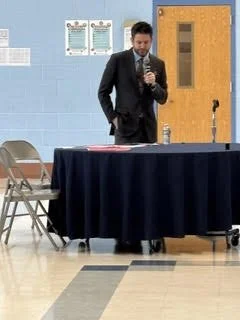
Nick Ianelli, WTOP News Anchor and Montgomery County resident, moderated both candidate forums.
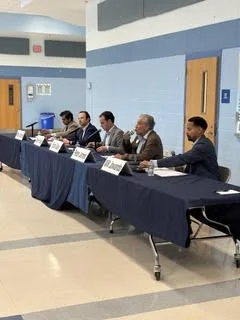
Democratic Forum candidates (L-R): Mithun Bangeree, Andrew Friedson, Evan Glass, Peter James, and Will Jawando.
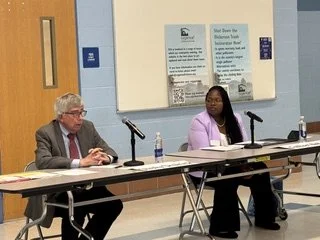
Republican candidates Shelley Skolnick (left) and Esther Wells (right) on May 7.
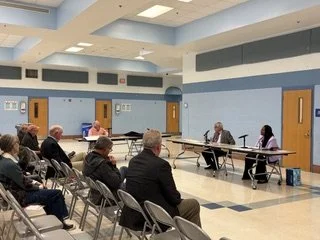
Shelley Skolnick (left) and Esther Wells (right) answered questions at the May 7th Republican Candidate Forum.
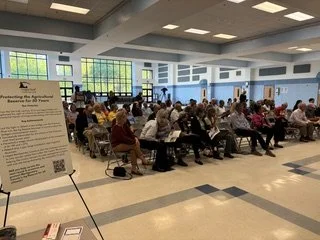
Democratic County Executive candidate forum on April 23.
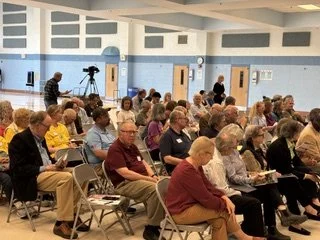
The Democratic County Executive candidate forum was held on April 23.